
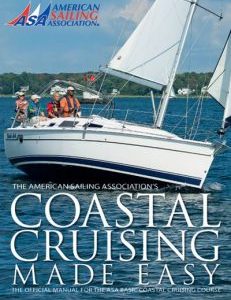
Learn Basic Coastal Cruising in Just 2 Days
So, you’ve learned the basics of keelboat sailing but now you’re ready to take the next step and gain more sailing experience. ASA 103 expands upon the skills you’ve learned in ASA 101 to prepare you to skipper a vessel in the day in moderate winds and sea conditions. With ASA 103, you’ll be certified to skipper a sloop-rigged auxiliary-powered boat of moderate size and gain deeper knowledge and skills in anchoring, docking procedures, basic coastal navigation, weather anticipation, and more.
What You’ll Learn in ASA 103 Basic Coastal Cruising
When you take Norton Yachts’ ASA 103 course, you’ll learn cruising sailboat terminology, navigation rules, the mechanics of basic boat systems, and more from the American Sailing Association. You’ll study knowledge and theory from a textbook and learn practical skills on the water from a certified ASA instructor. Your classmates will act as your crew as you learn hands-on in this 15-hour course. By the end of the course, you’ll be able to earn basic coastal cruising certification and take the next step in gaining advanced ASA certification.
Prerequisites for ASA 103 Basic Coastal Cruising
Before beginning ASA 103, you must have completed and gained sailing certification in ASA 101 Basic Keelboat Sailing. Norton Yachts routinely offers this beginner-friendly course; see our ASA 101 Basic Keelboat Sailing page for more information.
ASA 103 Basic Coastal Cruising Knowledge
The first portion of ASA 103 is textbook-based. book ASA 101 and ASA 103 at the same time and receive our combo package discount. Or sign up for our B2B (Basic to Bareboat; ASA 101, 103 and 104) and get certified in three classes being fully immersed on our boat for 6 consecutive days.
Cruising Sailboat Terminology
Identify and describe important terminology such as rudder post, compass, turnbuckle, auxiliary engine, and more.
Safety Equipment and Procedures
- List the federally required equipment for a 33-foot recreational vessel equipped with an inboard diesel engine.
- Describe the characteristics and benefits of Personal Flotation Devices.
- List the ASA-recommended safety equipment for a recreational sailing vessel.
- Describe ways to keep gear and equipment secure and in their proper location and the purpose and proper use of a safety harness and tether.
- Describe safe refueling procedures for a vessel equipped with an outboard engine.
Navigation and Weather
- Demonstrate understanding of basic coastal navigation terminology and practices, such as depth soundings, hazards, bottom types, essential navigating tools, and more.
- Describe how to prevent undue magnetic influence on a compass.
- Describe the dangers of, and how to avoid, a lee shore.
- Obtain and interpret marine weather information; describe the impact that present observations and forecasts may have on sailing plans for the next 6-12 hours.
- Describe and identify Cumulonimbus clouds and what dangers they may signify.
- Define ‘small craft advisory’ and ‘gale warning’ and describe precautions for each.
Sail Plan
- Describe the appropriate sail combinations for light, moderate, and heavy winds.
- Describe the procedures for heaving-to and reducing sail using a roller furling jib and a mainsail reefing system.
Seamanship
- Describe the responsibilities of a skipper and crew.
Describe the applicable rules for a 33-foot recreational sailing vessel in a variety of situations, such as:
- Proceeding at a safe speed, determining collision risk, and taking early and substantial action to avoid collision.
- Sailing vessels, overtaking, and power-driven vessels in head-on and crossing situations.
- Location, color, and illumination angles of required navigation lights at anchor, under sail, and under power.
- Actions to be taken when operating a sailing vessel in restricted visibility (fog or haze) including adaptation of speed and use of sound signals.
- Basic maneuvering and warning signals for inland waters.
- Describe the appearance and purpose of the ‘Diver Down’ and ‘Alpha’ flags.
- Describe common anchor types, major considerations for anchorage selection, and proper scope for short-term and overnight anchoring as well as storm conditions.
Emergencies
- Describe the three stages of hypothermia and name symptoms and treatment for each.
- Describe two methods for getting a person out of the water and safely back on board.
- Identify common sources and prevention of fires and/or explosions, as well as appropriate actions to be taken and the different types of fires and procedures for operating a fire extinguisher.
- Describe immediate actions to be taken when urgent situations arise, such as a failed steering system, engine failure, or cabin filling with water.
ASA 103 Basic Coastal Cruising Skills
After mastering the textbook portion, your knowledge will be put to the test as you go out on the water with your classmates and instructor.
Preliminaries
- Locate and examine the vessel’s federally required safety equipment.
- Demonstrate on shore or aboard the vessel the correct method for putting on a life jacket while in the water.
- Identify the vessel’s battery selector switch and power distribution panel; ensure all switches are in the proper position for getting underway.
- Ensure navigation lights operate properly.
- Perform a radio check using a working channel on the VHF radio.
Navigation
- Visually pilot the training vessel in and out of a harbor, correlating nautical chart symbols to actual landmarks and aids to navigation.
- Steer a compass course under power for a minimum of five minutes.
Under Power
- Inspect the auxiliary engine and demonstrate safe engine starting, operating, and stopping procedures and gearshift and throttle usage.
- Ensure vessel & crew readiness and depart dock or slip smoothly and under control.
- Approach a mooring buoy; stop the vessel within boathook reach; attach the vessel to the mooring using an appropriate line or bridle; cast off from the mooring and get underway.
- Set a bow anchor in water depth 8 feet or greater, using correct procedures including hand signal communication, vessel maneuvers, safety in handling ground tackle, and proper operation of windlass (if equipped). The anchor should hold with the engine in reverse gear at one-half throttle. Raise the anchor and get underway smoothly using the correct procedures.
- Describe and demonstrate the correct actions to be taken while under power from the time a person falls overboard until safely recovered.
Under Sail
- Hoist or unfoil sails correctly using halyards or furling devices, describe the effect on sail trim or performance while adjusting lines and controls such as the mainsheet and jibsheets, and demonstrate correct winch operation.
- Without coaching or assistance, verbalize and perform appropriate commands as a skipper and as a crew, such as heaving-to, getting out of ‘irons’, and appropriate actions to take if a person falls overboard, among others.
Return to Dock/Slip
- Ensure the vessel and crew are ready and use the auxiliary engine to bring the vessel smoothly to a stop next to a parallel dock or into a slip, then secure using appropriate lines and fenders.
Knots
- Describe the purpose of and demonstrate tying the knot without assistance for several types including figure-8, clove hitch, and bowline.

Getting more practice and learning new skills is made simple with Norton Yachts Sailing School ASA 103 course for just $695. To learn more and to enroll in ASA 103 or any of our other courses, click the Book Now button or contact us at 804-776-9211 or email at dockmaster@nortonyachts.com.